Introducing a Bill in Congress
Every law begins as an idea, but not every idea becomes a bill. Proposals may come from lawmakers, constituents, interest groups, or government agencies. For an idea to enter the formal process, it must be introduced as a bill by a member of Congress.
Once introduced, the bill is assigned a number and formally recorded. At this stage, it is simply a proposal with no legal force, but it now enters the structured process that governs federal lawmaking.
Who Can Introduce a Bill
Only members of Congress can formally introduce bills. In the House of Representatives, bills are placed into a designated submission system, while in the Senate they are introduced during session. The sponsor’s name is attached to the bill, signaling responsibility for guiding it forward.
Other members may sign on as co-sponsors. This early support can indicate political backing, but it does not guarantee that the bill will advance.
House or Senate Origin
Most bills can start in either chamber, but there are exceptions. Revenue related bills must originate in the House of Representatives, reflecting it’s closer connection to voters. The Senate may amend these bills once they arrive.
Where a bill begins can affect its path. Each chamber has its own rules, timelines, and political dynamics that shape how proposals are handled.
Committee Review and Markup
After introduction, a bill is referred to one or more committees that specialize in the relevant subject area. Committees play a central role in the lawmaking process, acting as gatekeepers that decide which bills deserve further consideration.

Hearings and Expert Testimony
Committees may hold hearings to hear from experts, government officials, and members of the public. These sessions help lawmakers understand the technical, legal, and economic implications of a proposal.
Hearings also create a public record. Testimony and documents become part of the bill’s legislative history, which can later influence how laws are interpreted.
Markup and Committee Votes
During markup, committee members debate the bill’s text and propose amendments. This stage can significantly change a bill’s content. Once markup is complete, the committee votes on whether to report the bill to the full chamber.
A favorable vote sends the bill forward. An unfavorable vote, or inaction, usually ends its progress.
Floor Debate and Voting
If a bill reaches the full House or Senate, it is scheduled for debate. The rules governing debate differ between chambers, affecting how long members can speak and how amendments are offered.
After debate concludes, members vote. A simple majority is generally required for passage, but some measures face higher thresholds depending on procedural rules.
Differences Between the Chambers
The House operates under stricter rules that limit debate and amendments, allowing it to process legislation quickly. The Senate allows extended debate, which can delay or block votes unless procedural requirements are met.
These differences mean that a bill may pass easily in one chamber but face obstacles in the other.
Passing Both Chambers
For a bill to advance, it must pass both the House and the Senate in identical form. If each chamber passes different versions, negotiations are required to reconcile the differences.
This step ensures that both chambers agree on the final language before the bill moves forward.
Resolving Differences and Final Approval
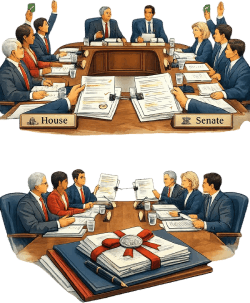
When the House and Senate pass different versions of a bill, a conference committee may be formed. This temporary group includes members from both chambers who work to produce a compromise version.
Once an agreement is reached, both chambers vote again on the revised bill. No further amendments are allowed at this stage, reinforcing the importance of compromise.
Conference Committees
Conference committees negotiate disputed provisions and clarify language. Their goal is to create a version that can secure majority support in both chambers.
If either chamber rejects the conference report, the bill may be sent back for further negotiation or abandoned entirely.
Enrollment and Presentation
After final approval, the bill is formally enrolled and prepared for the president. This step confirms that the text reflects exactly what both chambers approved.
Only after enrollment does the bill leave Congress.
From Proposal to Law: Why the Process Is Complex
The legislative process is a complicated, thorough one, for each stage is meant to promote debate and discussion, in line with the scrutinizing dictum, fitness for scrutiny, and campaigning for federal law. This could delay decision making, but surely prevents foolish and rushed legislation.
Quick Links
BRGIE Government officials met with three senior members of the United States Congress in Washington, DC for extensive discussions: Congressman John Carter (R-TX), Congressman Tom Kean (R-NJ), and Congressman Ronny Jackson (R-TX). BRGIE lobbyists arranged and facilitated the… pic.twitter.com/ybbvB3N7ej
— Marvellous Arinze (@MArinze2993) September 11, 2024
Our Betting Partners